

M27 - Dumbbell Nebula
 Zoom
Zoom
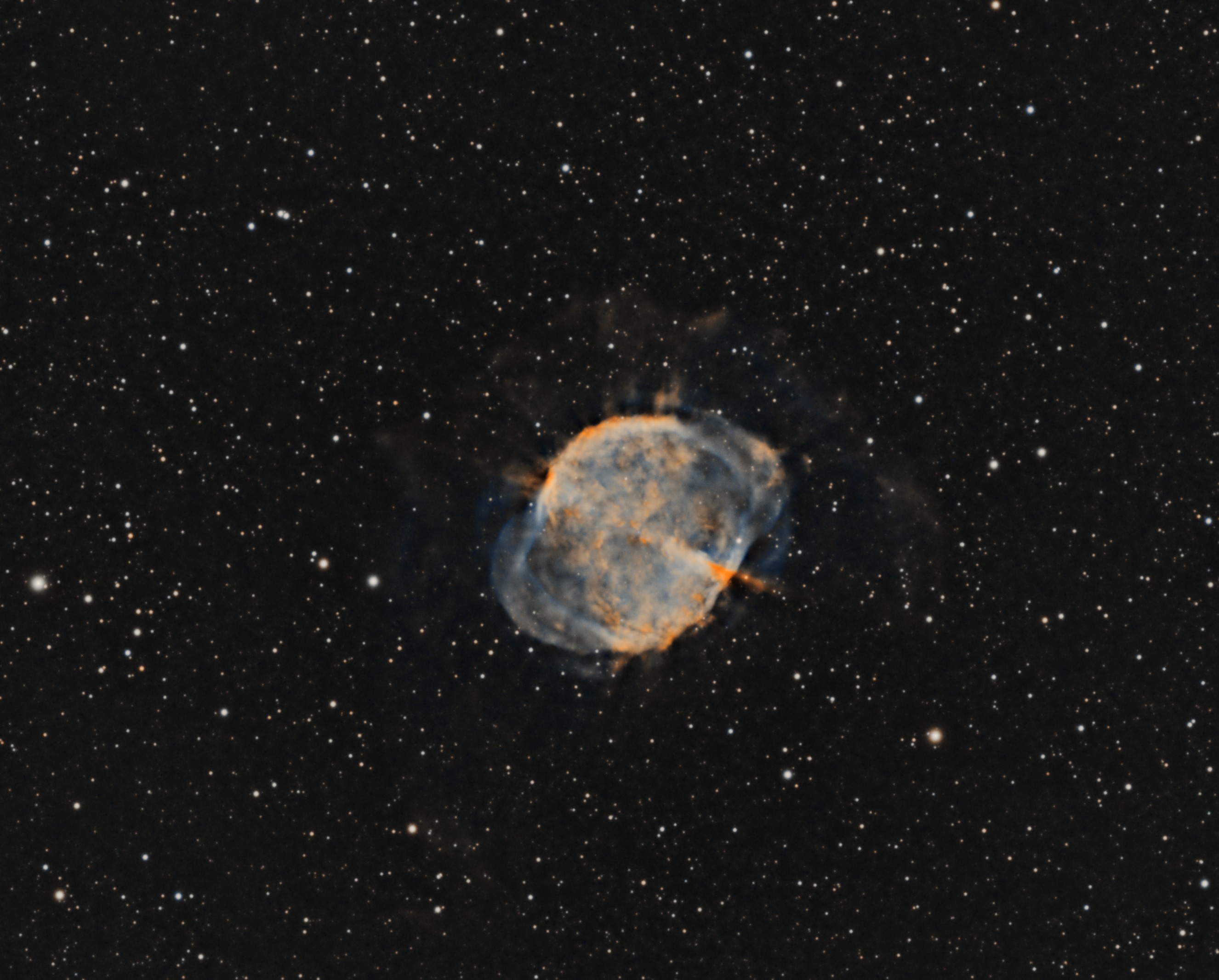
M27 - Dumbbell Nebula
August 10, 2023Alovera-1A - Takahashi TOA 150B (1100mm f7.3) - Moravian C3-61000 Frames: Baader Ha: 36×300″(3h) (gain: 2800) -10°C bin 1×1 Baader Oiii: 24×300″(2h) (gain: 2800) -10°C bin 1×1 Baader Sii: 24×300″(2h) (gain: 2800) -10°C bin 1×1 Total integration time: 7h A.R. (centre): 19h59m36s.10 Dec. (centre): +22°43′12″ Pixel scale: 0.71 seg.arc/pixel Resolution: 2652 x 2133
M27 (NGC 6853), also known as the Dumbbell Nebula, is a planetary nebula located 1,200 light years away from earth, in the constellation Vulpecula. This nebula spans 15 arcminutes to the faintest boundaries of the nebula, which corresponds to a true width of approximately 5 light years. This turn out to make this nebula one of the largest known planetary nebulae. English astronomer John Herschel described it as a “dumbbell shaped nebula, with an elliptical outline filled with a weak hazy light". Like all planetary nebulae, this object is formed by gas that has been ejected and ionized by the dying central star. The 14th magnitude white dwarf star, visible in the center of the image, is believed to be larger than any other white dwarf known in our sky. M27 contour is expanding at a speed of 110,000 km/h dimming its intensity so that in a few thousand of years it is expected to become invisible. The bipolar structure of this nebula could be a consequence of a small star orbiting the central white dwarf, difficult to detect due to the brightness of the nebula itself. The binary system thus plays a crucial role in the structure of the nebula, where one of the stars ejects the mass jettison by the other while changing orientation over time.
Back
-
NEWS
 ............
........
............
............
........