
ALOVECIENCIA
Laser: how it works
Talk: 21th March 2024, 19:00, Conference Hall/Library of Alovera.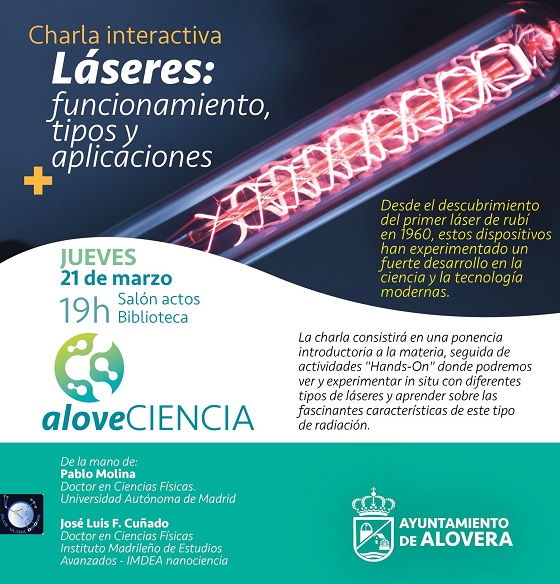
This talk will be given by Pablo Molina (Universidad Autónoma de Madrid - Dpt. Física de Materiales).
Experiments will be done by José Luis F. Cuñado (IMDEA nanociencia, Nanomagnetism Group) and Pablo Molina.
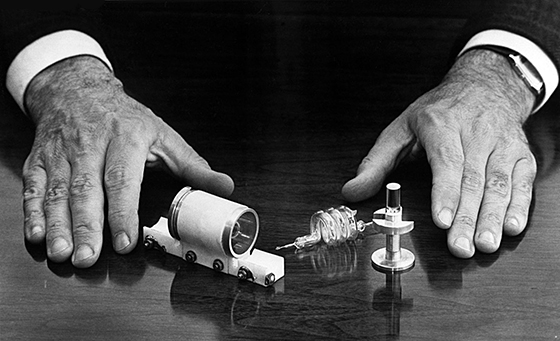
LASER stands for Light Amplification by Stimulated Emission of Radiation, a kind of light source capable of generating beams of
monochromatic, coherent and highly directional electromagnetic radiation. Since the discovery of the first ruby laser in 1960, these
devices have experienced strong development, finding countless applications that have extraordinarily expanded the horizons
of modern science and technology. Indeed, a wide variety of laser configurations or types are currently available, with sizes ranging from
large, high-power lasers designed for nuclear fusion experiments or gravitational wave detection, to miniaturized lasers in the form of
optical fibers or compact micro-chips, like those used for implementating large data networks.
 In this presentation we will make a brief introduction to the basics of light amplification through stimulated emission
in order to understand its working principles. Later we will describe the main types of lasers and finally we will present
some of the most cutting-edge applications in the current scientific and technological panorama.
In this presentation we will make a brief introduction to the basics of light amplification through stimulated emission
in order to understand its working principles. Later we will describe the main types of lasers and finally we will present
some of the most cutting-edge applications in the current scientific and technological panorama.
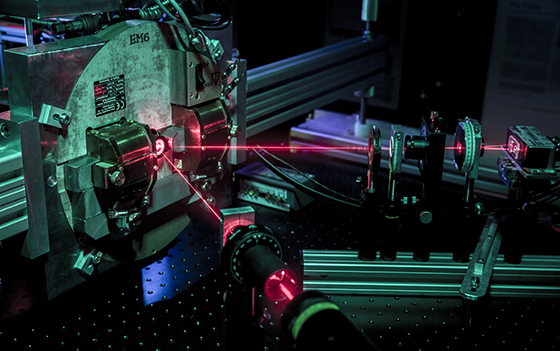
This talk serves at the same time as the inauguration of the mini-exhibition "Dismantling the laser", which will take place in the exhibition hall of the Alovera's library. The exhibition will consist of two display cases with several disassembled lasers accompanied by explanatory panels. On designated days, José Luis F. Cuñado will make short in-situ passes for explanations. Find out more in the library information desk.
Included in the Alovera's CULTURAL PASSPORT
Back-
 ............
............
...........
............
............
............
...........