
ALOVECIENCIA
Eclipses
Talk: 21st May 2026, 18:00, Conference Hall/Library of Alovera.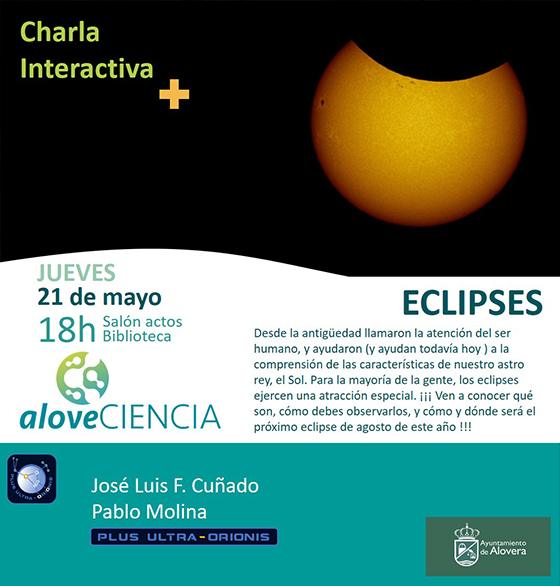
The talk will be given by:
Dr. José Luis F. Cuñado, IMDEA nanociencia, PlusUltra - Orionis.

How much do you know about the sun? Today you'll learn that eclipses were crucial for studying it...
We all know many things about the sun, Such as that it is a gigantic ball of plasma and that nuclear fusion processes occur within it. However, reaching our current level of understanding of this colossal machine that provides us with light and heat has taken several centuries, and it remains a very active area of research, where theories formulated just over half a century ago are being refined little by little. Eclipses have played a crucial role from the beginning: thanks to them, it was possible to determine, beyond any doubt, that the Sun possessed an atmosphere; not an atmosphere like ours, but a plasma atmosphere that, strangely enough, is much hotter than the Sun's surface itself. This solar atmosphere, called the corona, is so tenuous that the scattering of sunlight by our own Earth's atmosphere prevents its observation. However, it can be observed during eclipses, provided the conditions are right (clear Earth's atmosphere and sufficient altitude). In this talk, we'll cover three essential aspects of observing the eclipse, suitable for everyone. Afterward, we'll give a very brief introduction to heliophysics, the science that studies our sun.
The talk
-
 ............
............
...........
............
............
............
...........